
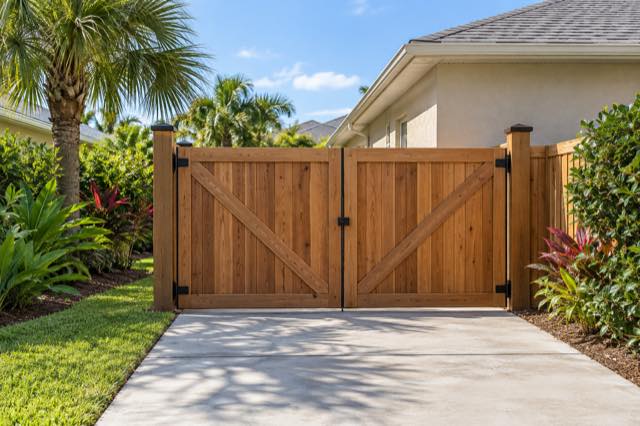
01 / GATES & ACCESS
Start with the equipment, not a standard size.
List the mower, trailer, garden cart or service equipment that may need to pass. Use actual dimensions, including attachments and anything that extends beyond the wheels. Add the information to the brief without treating a rough measurement as an installation specification.
Think about future needs that are realistic for the property. An occasional equipment visit may justify an access plan, but it does not automatically justify the widest possible gate. Compare the benefit with the space needed to operate and secure it.
02 / GATES & ACCESS
Draw the entire route.
Mark the approach outside the fence, the gate opening and the path beyond it. A narrow turn, tree or paved corner can limit access even when the opening itself is wide. Include those turning and clearance constraints when you contact our team about your gate quote request.
Consider where each leaf rests when fully open and how it will be held there. Include uneven ground, landscaping and nearby objects. Do not assume that a wider version of a pedestrian gate uses the same supporting arrangement.
03 / GATES & ACCESS
Specify the parts that make a pair work.
Discuss the gate framework, supporting posts, hinges, latch and the way an inactive leaf is secured. Ask how the two leaves align when closed and what routine checks the chosen hardware needs.
State whether the gate is manual. Powered operation, vehicle access controls and electrical work are separate scopes that require qualified design and providers. A residential fence-gate discussion should not quietly expand into an unspecified automated gate system.
MAKE IT USEFUL
Your equipment-access brief.
Select the details you want to discuss with our team. Keep a copy for your project notes.
One more thing.
Will a double gate solve a tight turn?
Not necessarily. The opening and the approach are different constraints. Review the complete movement path before choosing the gate location or width.